A landscape can contain rocks a metre from the camera and hills kilometres away. Focusing on the hills does not guarantee sharp foreground rocks. Focusing on the nearest rock does not guarantee sharp hills either.
Choose a scene you can compare
A static landscape with detail at different distances. This lesson assumes the camera position is stable and the scene has near and distant details to inspect. Compare the original files at the same magnification, not differently cropped previews. Moving foliage, water, and wind can introduce blur even when your focus choice is sensible.
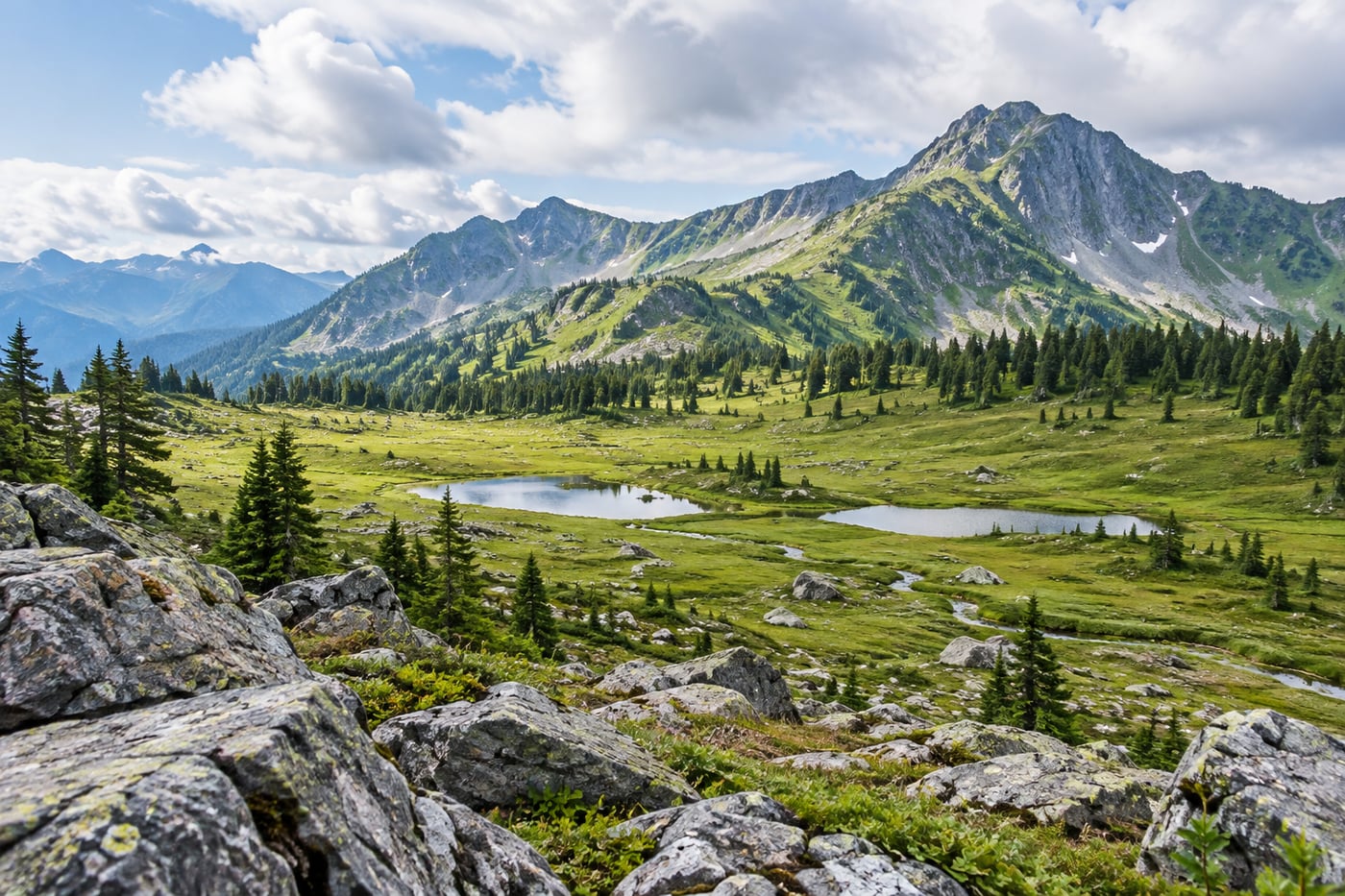
Choose the details that matter, then check whether your settings keep them sharp enough for the final photograph.
Start with the distances in your frame
A scene without a very close foreground is usually easier to manage. At a moderate aperture, focusing on an important middle-distance feature may give a useful result. A close flower or rock changes the problem because it demands more depth of field.
There is no universal “focus one third into the frame” rule. A third of the picture’s height is not a measurement of subject distance, and two scenes with similar framing can have very different distances.
Use a moderate aperture first
On many cameras, f/8 is a reasonable starting point for a broad daylight scene. It is not a guarantee. Make a frame, then magnify a near detail and a distant detail in playback.
If the important areas are not sharp enough, try a narrower aperture and repeat the comparison. Very small apertures can reduce fine detail through diffraction. Whether the trade-off is worthwhile depends on the camera, output size, and scene.
Change the frame when depth of field is insufficient
Sometimes the easiest fix is to move the camera farther from the foreground or remove the closest object from the composition. This reduces the distance range you need to cover.
Before considering a complicated technique, ask whether that foreground object improves the photograph. A sharp object at the bottom of the frame is not useful merely because it is close.
Keep movement separate from focus
A tripod steadies the camera. It does not stop wind-blown leaves or flowing water. If those details need to look still, choose a faster shutter and raise ISO if required.
For still scenes with a long exposure, use stable support and a timer or remote release. Check your manual for stabilisation behaviour on a tripod.
When focus stacking may help
For a stationary scene, several frames focused at different distances can be combined in compatible software. This is called focus stacking. It takes more care than a single frame: camera position and exposure should remain consistent, and moving plants or water can create blending problems.
Inspect a single frame before deciding whether the scene needs stacking.
A field check you can repeat
- Identify the nearest and farthest details you want sharp.
- Choose a moderate aperture and an initial focus distance.
- Make a frame and magnify both areas.
- Adjust focus, aperture, or composition, then compare again.
See depth of field basics and the landscape practice lesson for the related controls.
If only the foliage is soft, check for wind movement. Compare a moderate aperture if a very small one makes the whole frame softer. In a stacked file, inspect moving water and leaves for blending errors, even when the individual frames look plausible.
Related lessons
- Where to Place the Horizon in a Landscape Photo
- Why a Wider Lens Does Not Automatically Fit More Into a Better Photo
Leave a Reply